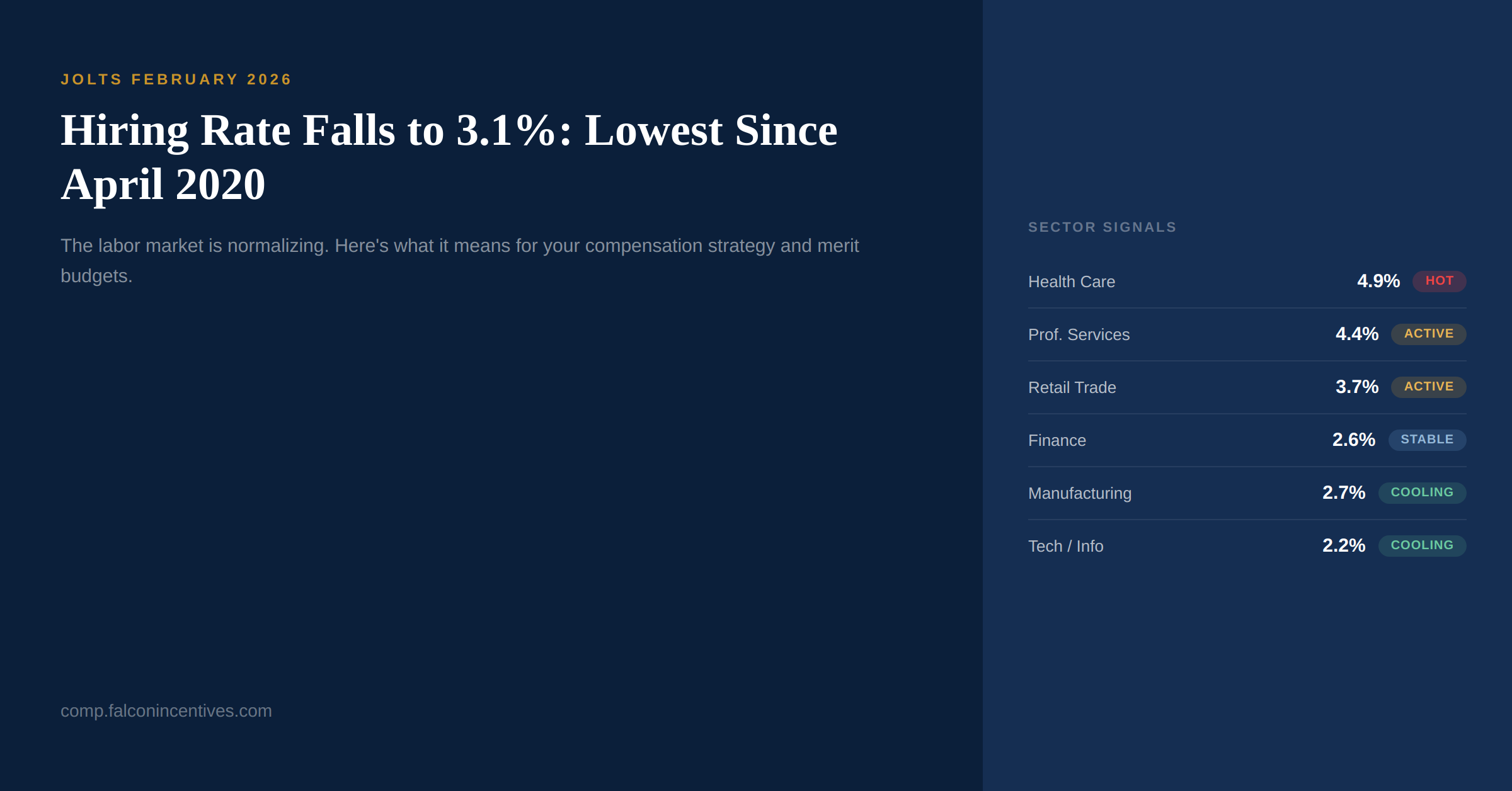
The Bureau of Labor Statistics released the February 2026 JOLTS data on March 31, and the headline number caught most people off guard: hiring rate fell to 3.1%, the lowest since April 2020.
This isn't a recession signal. It's something more subtle and more relevant for compensation teams: the labor market is normalizing, and the power balance between employers and employees has quietly shifted.
Here's what the data says and what to do about it.
The February 2026 snapshot
| Metric | Value | Change |
|---|---|---|
| Job openings | 6.9M | −5.0% MoM |
| Hires | 4.8M | −9.4% MoM |
| Total separations | 5.0M | −2.0% MoM |
| Quits rate | 1.9% | −0.1pp |
The quits rate has been at or below 2.0% for eight consecutive months. In 2022, it was 2.9%. This is the clearest indicator of what economists are calling the “Great Stay.” Employees aren't leaving, even when they're not thrilled. The cost of switching has risen (remote work pullbacks, equity vesting cliffs, uncertain market), so people are staying put.
Sector-by-sector breakdown
Not all sectors are moving in the same direction. Here's where the pressure is:
| Sector | Openings Rate | Quits Rate | Signal |
|---|---|---|---|
| Health Care & Social | 4.9% | 2.3% | Hot |
| Prof. & Business Services | 4.4% | 2.6% | Active |
| Accommodation & Food | 5.0% | 3.2% | Active |
| Finance & Insurance | 2.6% | 1.2% | Stable |
| Manufacturing | 2.7% | 1.6% | Cooling |
| Information (Tech) | 2.2% | 1.3% | Cooling |
Health Care remains the tightest market in the economy. An openings rate of 4.9% means employers are still competing hard for talent. If you're hiring Registered Nurses or Physicians, expect to pay at or above P75 to close candidates.
Tech is the opposite story. A 2.2% openings rate and 1.3% quits rate (the lowest in the JOLTS dataset) means tech employers have maximum leverage. If you've been stretching offers to match FAANG counteroffers, you can recalibrate. The market has given you permission.
Professional Services is the only sector where openings actually grew in February (+64K). If you're hiring HR Specialists, consultants, or specialized white-collar roles, the market is still moderately active.
What this means for your merit budget
The latest Employment Cost Index (ECI) shows overall wage growth at 3.3% year-over-year (Q4 2025). But the sector spread is wide:
- Information & Tech: 5.1%
- Financial Activities: 4.8%
- Health Care: 4.2%
- All civilian average: 3.3%
- Leisure & Hospitality: 3.1%
If your merit budget is at 3.5% across the board, you're keeping pace with the national average but falling behind in tech and finance. The ECI data suggests differentiation: allocate more to sectors where wage growth is outpacing your budget, less where it's below.
A blunt 3.5% applied equally to a Software Developer (5.1% sector growth) and a Hospitality Manager (3.1% sector growth) means you're slowly losing the developer and overpaying for the hospitality manager. Neither outcome is what you want.
Three things to do this quarter
1. Audit your wage position. Use CompSignal to check where your key roles sit in the P10–P90 distribution. If you're at P60 in a cooling sector, you're fine. If you're at P40 in healthcare, you have a retention risk.
2. Recalibrate offer premiums by sector. The “stretch 10–15% above market” playbook from 2022 is outdated in cooling sectors. Tech and manufacturing offers can now land at P50–P60 and still close. Healthcare still requires P75+ premiums.
3. Differentiate your merit budget. Use ECI sector data to justify above-average increases for roles in hot sectors and at-average for the rest. Present the data to your comp committee. The BLS numbers give you cover for a differentiated approach.
Where to get the data
JOLTS and OEWS data are published by the Bureau of Labor Statistics and made searchable through CompSignal. You can check wage percentiles for any role in any geography, see the JOLTS sector signal, and compare market context. Free, no account required.
The next JOLTS release (March 2026 data) is expected in early May. The next OEWS refresh (May 2025 vintage) will publish in late 2026.
Check your sectors. Open CompSignal: JOLTS signals + BLS wage data for 755+ occupations.
CompSignal is built by Falcon Incentives, a compensation strategy consultancy for US companies.