An auto distribution case study, eight weeks, and the math behind the unbundled SPM stack.
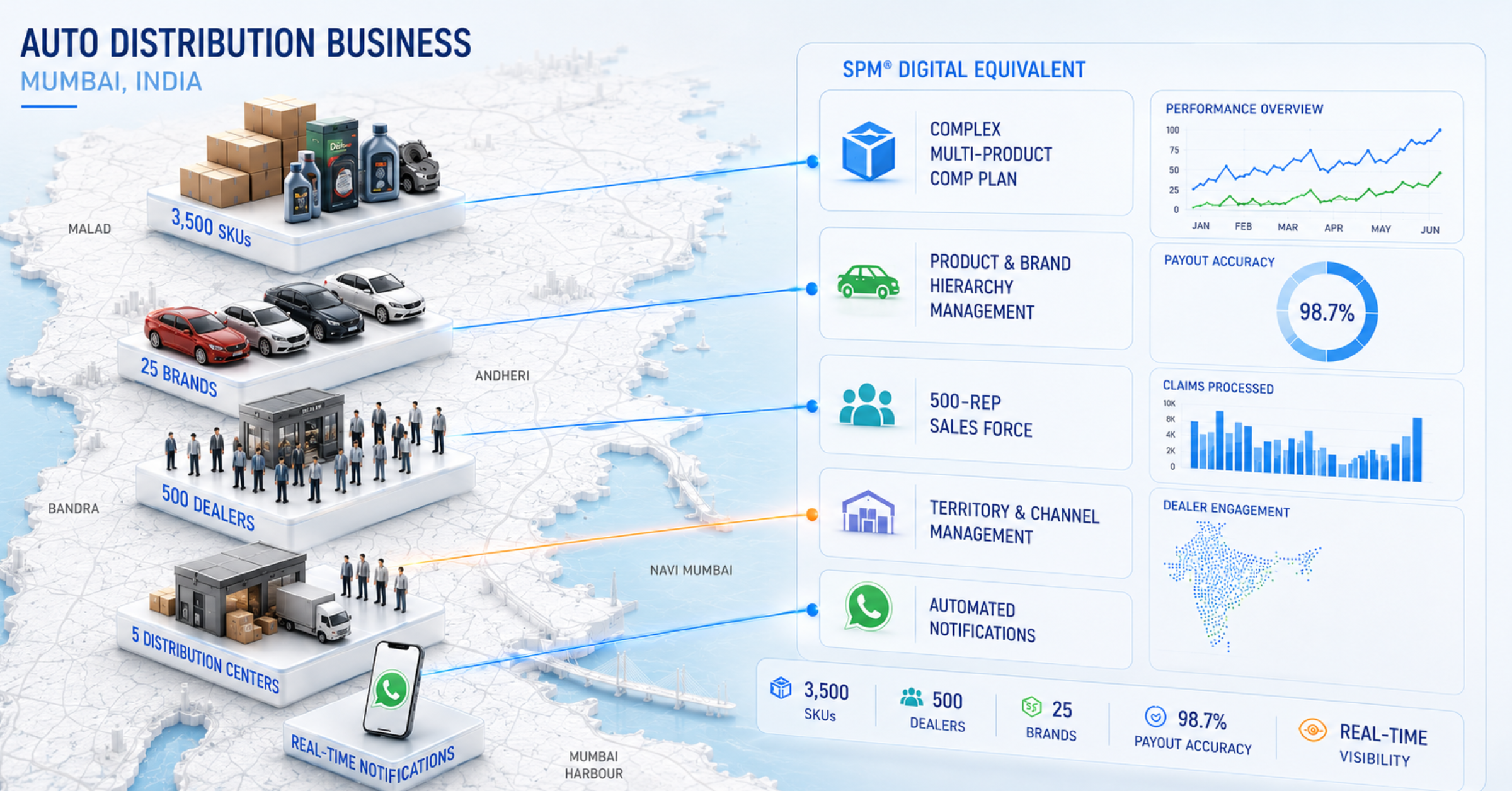
In Mumbai, a company called OMPV distributes auto accessories across Maharashtra and the neighbouring states. They cover more than 300 car models, with 12 to 15 accessories per model plus colour variants, totalling more than 3,500 SKUs. They sell through 500-plus dealers, and every dealer has custom pricing on every product variant based on their sales profile. Five different stakeholder groups interact with the system: dealers, sub-dealers, accountants, back-office staff, and admins. KPIs are tracked at dealer level, city level, and geographic region. AI sits inside the analytics layer. WhatsApp handles order confirmations automatically. Email keeps the network informed.
Brief to deployment took under eight weeks.
Now read that paragraph again with comp practitioner eyes. 500 dealers is a 500-rep sales force. 3,500 SKUs with custom pricing is a complex multi-product comp plan. Five stakeholder roles is rep, manager, comp admin, finance, and exec. KPIs at dealer, city, and geo level is performance dashboards at rep, manager, and territory level. WhatsApp and email notifications is statement delivery. AI in the analytics layer is the modern comp insights pitch.
What you are looking at is functionally a Sales Performance Management platform missing exactly one layer: a calculation engine that turns transactions into commission accruals, plus a payout layer. That is two to three additional weeks of work for a team that knows what they are doing.
If a Mumbai distribution business can have all of this in two months, the question every comp leader should be asking is why we are paying 200,000 dollars a year for a platform we use 20 percent of.
The question nobody asks in the SPM RFP
The standard buying motion in sales comp goes like this. Shortlist three vendors. Sit through demos. Read G2 reviews. Negotiate the license. Pick the one with the cleanest rep statement screenshots and the friendliest customer success rep.
Nobody asks the prior question, which is whether you need a platform at all. The bundled SPM platform was the right answer in 2014, when integrating five tools cost more than buying one. That economic case has quietly collapsed, and most mid-market buyers have not noticed yet.
This piece is for the ones who are about to renew. The argument is straightforward. The build-versus-buy math has flipped. For most mid-market comp programs, a custom-built composed stack is now faster to deploy, cheaper over a three-year window, and a better fit to the actual business than any bundled vendor platform. The remaining advantages of platforms are real but narrower than the vendor pitch suggests, and a working comp practitioner can tell you exactly which ones still matter.
The six building blocks of sales comp
Most buyers have never seen SPM decomposed, because vendor demos are organised by feature rather than by function. Strip the marketing away and you find six building blocks.
Master data. People, plans, quotas, territories, hierarchies. The reference data everything else depends on.
Transaction data. Deals, splits, adjustments, returns. The events that drive payout calculation.
Calc engine. The rules that turn transactions into commission accruals. Splits, accelerator tiers, draws, clawbacks, SPIFFs, retroactive recalculation. This is where comp logic lives.
Statement layer. What the rep sees. The monthly or quarterly document that explains how their pay was calculated.
Workflow. Plan rollouts, plan signoff, dispute intake, exception approvals, audit logging.
Presentation. Dashboards, mobile apps, leaderboards, manager views.
In 2018, every one of these layers was a vendor problem. You bought an SPM platform because building any of them yourself was prohibitive. By 2024, five of the six were commodity. Master data and transaction data live in your CRM and HRIS, accessible directly. Statements are PDF generation plus a template. Workflow is n8n or a custom Slack bot. Presentation is whatever interface the user already lives in.
That leaves the calc engine, which is the only layer that still demands real engineering. And here is where the most recent shift matters most. Claude Code and similar tools have changed what one careful engineer can produce in a week. A calc engine that used to require three months of Java work and a vendor-trained consultant is now buildable as version-controlled Python by an analyst with comp expertise.
The platforms still bundle all six layers and charge accordingly. The market has not caught up to the fact that five of the layers are no longer scarce.
Proof: OMPV in eight weeks
Take OMPV's actual deliverable and lay it next to a typical SPM platform implementation.
OMPV needed master data for 500 dealers, 3,500 SKUs, and custom price tables for every dealer-SKU combination. A comp deployment needs master data for the rep population, plan documents, quota tables, and territory assignments. Same problem shape, same solution pattern.
OMPV needed transaction data flowing in from the ordering system, with role-appropriate visibility and audit logging. A comp deployment needs transaction data flowing in from Salesforce or HubSpot, with the same access controls. With Salesforce Headless 360 and hosted MCP servers now generally available, this integration is no longer the multi-week ETL exercise it used to be.
OMPV needed five role-tailored views: dealer, sub-dealer, accountant, back-office, admin. A comp deployment needs four to five role-tailored views: rep, manager, comp admin, finance, exec. The pattern is identical.
OMPV needed AI-integrated analytics that could answer natural language questions across the dataset. So does a modern comp program, and this is where most legacy SPM platforms are now playing catch-up.
OMPV needed automated communications via WhatsApp and email. A comp deployment needs the same, branded as statements and notifications.
What OMPV did not need is the calculation engine, because an auto distribution business does not pay commissions on margin. That is the gap. And the gap is buildable. Two to three additional weeks for the calc engine, plus a payout layer that schedules and tracks accruals to actual payments. Add another week for SOX-compliant audit logging if finance requires it.
Total: eight weeks of platform engineering plus three to four weeks of comp-specific work. Twelve weeks, end to end. Most SPM vendor implementations run four to six months and require a dedicated implementation manager from the customer side throughout.
What custom comp gets you that a platform cannot
The first benefit is fit. A custom comp system is built around your actual plan, not your plan forced into the vendor's data model. Comp leaders know the cost of this because they have all sat in the meetings where the vendor's account manager explains why your specific accelerator structure cannot be modelled and you will need to simplify the plan instead. Custom builds do not have that conversation.
The second benefit is speed on plan changes. The single most painful operational reality of comp is that plans change mid-period. New product line. Acquired team on a different structure. Mid-year quota adjustment because the market shifted. In a platform, this triggers a change order, a configuration cycle, and a re-test. In a custom system, it triggers a pull request.
The third benefit is the absence of a license cliff. Per-rep pricing punishes growth. The platform that costs 80,000 dollars a year at 100 reps costs 320,000 a year at 400 reps, even though the calc complexity has not changed. Custom systems scale on infrastructure cost, which is sub-linear and small.
The fourth benefit is integration freedom. With MCP, your custom system can talk to any data source the same way an agent does, without waiting for the vendor to ship a connector. This is the structural reason platform pricing power is eroding.
The fifth benefit is auditability your finance team can read. The audit trail lives in your own database, in tables you control, on a schema your finance team designed with you. SOX evidence is straightforward instead of a vendor support ticket.
The trade-offs of building custom
Someone has to own the calc engine. Either you take it on internally, or Falcon Incentives maintains it for you under a retainer. Your choice, made up front. That is the trade. The vendor's value, the part that is genuinely worth paying for, is that they have written and debugged calc logic for thousands of edge cases over many years. Whoever owns the build owns those edge cases.
The edge cases that matter:
- Splits across multiple reps on a single deal, with credit allocation that has to reconcile to 100 percent and survive an SDR-AE-CSM split scheme.
- Draws against future earnings, with recovery logic that handles partial recovery, full recovery, and write-off depending on the plan.
- Clawbacks on cancelled or returned deals, with the time window and reversal rules that vary by plan year.
- Accelerator tiers with multipliers, where the math depends on cumulative attainment and the boundary cases between tiers create disputes.
- Quota relief during medical leave, parental leave, territory transfers, or product launches, with proration logic that finance will audit.
- Retroactive recalculation when a plan changes mid-period, which has to be a one-button operation or it will not happen.
- SPIFFs that expire, ride-alongs, manager overrides, and exception approvals that need a chain of custody.
None of these are unbuildable. All of them have to be designed in from day one. The failure mode for custom comp is hiring a generic software firm that builds a beautiful platform and then discovers in month four that splits were never modelled, draws were not handled, and the audit trail does not capture exception approvals. Two more months get burned retrofitting, and the project crosses into a budget overrun that gives the platform vendor an opening to come back in.
The expertise is not in the engineering. It is in knowing what to engineer for. That distinction is the difference between a custom comp system that runs cleanly in year three and one that quietly returns the buyer to the platform vendor with a fatter cheque.
Why Falcon Incentives sits in the middle
Most custom-software firms can build the platform. They have the engineering chops, the project management, the deployment muscle. They built OMPV. What they do not have is comp domain expertise, and they will not know to ask about splits and draws until the customer surfaces them in user testing, which is too late.
Most comp consultants understand the logic. They have spent careers in plan design, dispute management, and quota setting. What they do not have is the engineering capability to ship a platform, and they will quietly recommend an SPM vendor because that is the only path they know to a working system.
The combination is rare. Falcon Incentives sits in the middle because we have done both. The OMPV-class platform engineering on one side, and 15-plus years of comp implementation experience on the other, including direct work on Optymyze and engagements across the WorldatWork ecosystem. We diagnose the plan, design the calc logic, ship the platform, and stay through audit. The same firm, the same engagement.
What this looks like for a mid-market buyer
The path is straightforward, and it sums to twelve weeks end to end.
Start with a two-week discovery sprint. We map your current plan, your current data sources, and your current pain points. The output tells you whether your problem is the plan itself, the system running it, or both. No platform fixes a broken plan, and you should know that before you commit to infrastructure.
From there, two weeks in design. Plan logic mapping. Edge case inventory. Integration design across CRM, HRIS, and payroll. Role views. Approval workflows.
Build phase runs eight weeks, with comp expert and engineer in the loop together throughout. The deliverable is a working composed stack on your infrastructure, with documentation finance can audit. Plans with unusual complexity may stretch the build by a week or two — we will tell you that up front, not at month four.
Ongoing engagement is a maintenance retainer covering plan revision support, audit support, and incident response. A fraction of typical SPM license cost annually, and it scales with complexity rather than headcount.
Total three-year cost, including build and maintenance, runs at roughly 30 to 40 percent of an equivalent SPM platform license over the same window. The system is yours at the end of it.
Conclusion
The platform vendors will spend the next two years writing whitepapers explaining why none of this is happening. It is happening anyway. The buyers who move first will spend a fraction of what their peers spend, on systems that fit their business exactly rather than the other way around.
Falcon Incentives designs and builds custom comp platforms for US companies. Twelve weeks from brief to live system. Comp domain expertise and platform engineering under one roof, deployed on your infrastructure, with documentation your finance team can audit and your operations team can maintain. The system is yours at the end of it.
If you are renewing an SPM license in the next twelve months, talk to us about a custom build before you sign. The renewal decision should not be made on vendor demos alone.
Build a custom SPM platform that fits your business.
Twelve weeks from brief to live system. Yours at the end of it.
Talk to us about a custom SPM build →