Every Sales Performance Management (SPM) contract has three costs. The first is on the vendor's pricing page: per-rep license. The second is in the statement of work, or SOW: professional services. Both are visible, both are negotiable, both are line items on the contract your finance team will review.
A fourth cost is starting to appear in contracts written this year, around AI agents, workflow consumption, and usage-based fees for the agent-native features vendors are bolting onto their platforms. That conversation deserves its own piece. The one below is about the third.
The third cost does not appear anywhere.
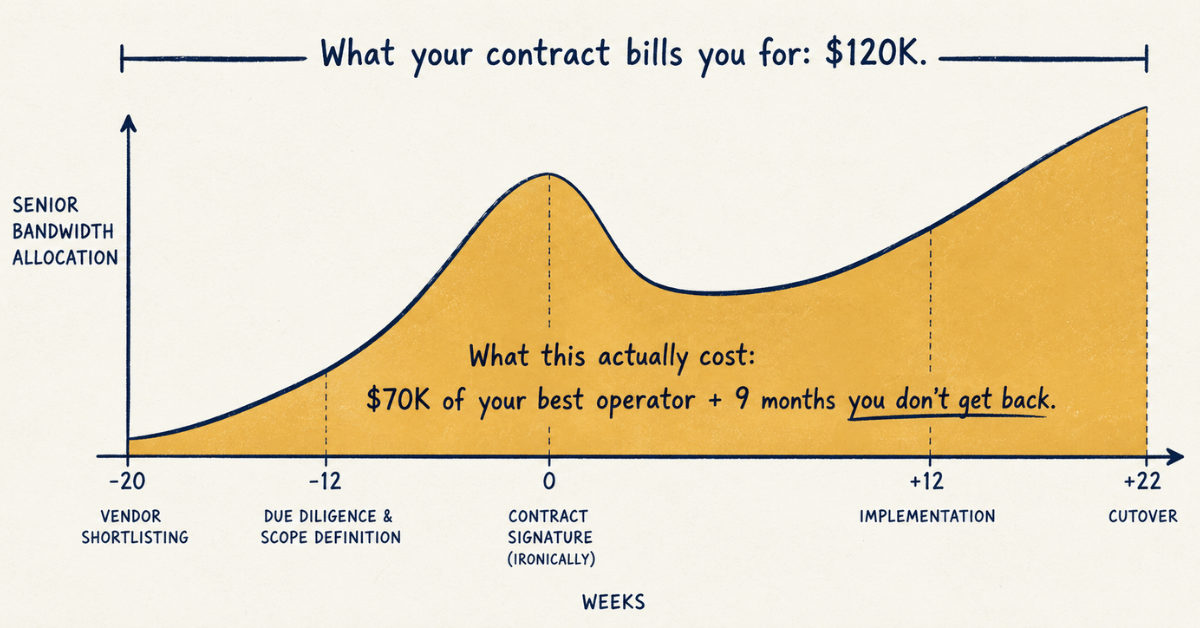
It is the bandwidth tax on your most senior Sales Ops operator, accumulated across nine months of vendor evaluation, contract negotiation, implementation, and stabilisation. It is paid in opportunity cost, in deferred operational work, in burnout that compounds into the year after go-live. Over a three-year ownership window it is the largest of the three costs. Almost no one puts it in their total cost of ownership (TCO) model.
This piece is about that cost. What it actually looks like, week by week, on the customer side. Why TCO models ignore it. And how a founder-led custom build collapses it by an order of magnitude.
The implementation cycle, week by week
Twenty-two weeks of customer-side commitment to bring a vendor SPM platform from contract to stabilised production. Click any phase for the detail.
Kickoff with the vendor's implementation team. A Sales Ops Director gets assigned as the customer lead, formally at 30 percent time allocation.
Plan documents pulled into structured format. Edge cases catalogued for the vendor to review. Integration map drawn across CRM, HRIS, and payroll systems. The 30 percent allocation becomes 50 percent in week three.
The vendor configures based on the requirements documents. The Sales Ops Director signs off on every screen, every workflow, every report layout, every notification template.
The Director builds test scenarios that reflect real plan behaviour. Runs them. Finds the gaps where the configuration does not match the plan. Sends them back for rework. Tests again.
The Director coordinates with IT, the CRM admin, the HRIS administrator, and finance. Test data flowing across all systems.
The Director runs sessions for managers, reviews the first cycle of statements, handles the first wave of disputes coming out of the new system.
That is just the post-contract cycle. The tax begins much earlier.
The tax begins before the contract signs
Twenty more weeks of customer-side bandwidth, invisible on every vendor's pricing page, that ends the day before week 1 of implementation. Most TCO models miss this part entirely.
Sales Ops Director drafts requirements, gathers input from finance, IT, and field leadership. Two to three meetings per week.
Outreach to four or five SPM vendors. Discovery calls scheduled. Initial demos booked.
Full demos with three shortlisted vendors. Internal scoring, follow-up questions, technical deep-dives, reference calls, occasional site visits.
Pricing, statement of work (SOW), terms, professional services scope, service-level agreements (SLAs). Legal review on the customer side. Procurement involved.
Final internal alignment, contract execution, kickoff prep with the vendor's implementation team.
Full tax across the cycle: 42 weeks, $70K of customer-side labour, four to six months of senior bandwidth at peak. The evaluation portion is unavoidable in any sourcing decision. The question is whether the cycle is 20 weeks or 3.
Where the bandwidth actually goes
Seven activity buckets do most of the work. Each one is real, each one takes real hours, each one is invisible on the vendor's pricing page. Click any card for the detail.
PDF plan to vendor's data model. Three to four iteration cycles before configuration starts.
Hundreds of configurable screens. Each one needs explicit approval.
Vendor QA tests their config. You design tests against real plan behaviour.
CRM, HRIS, payroll. Three to four systems to align.
Field training, manager comms, statement explainers, dispute prep.
Finance evidence requirements rarely match vendor defaults.
Things will go wrong. Tickets, missed SLAs, behaviour gaps. Someone escalates.
Add it all up and you get 50 to 70 percent of a senior full-time equivalent (FTE) for four to six months. That is the role the vendor does not staff.
Calculate the tax for your situation
The defaults below are calibrated to the math in this piece: a $200,000 fully loaded Sales Ops Director, 20 weeks of pre-contract bandwidth at 12 hours per week, 22 weeks of implementation at 55 percent allocation. Your situation will differ. Move the sliders. The widget recomputes the vendor SPM cost and the founder-led custom build estimate against your inputs.
Plug in your numbers.
The math holds the salary base across both scenarios. What changes is the cycle length and the bandwidth allocation.
The custom build estimate uses Falcon's measured pattern: roughly 3 weeks of pre-contract conversation at 6 hours per week, plus 10 weeks of build at 4 hours per week from the plan owner. The hourly rate scales with your salary input. The bandwidth assumptions do not, because the founder-led structure is the source of the compression.
Vendor SPM vs founder-led custom build
Same Sales Ops Director. Same fully loaded salary base. Two paths. The bandwidth math falls out like this across the full sourcing-to-cutover cycle.
The 58 hours figure includes evaluation. For the implementation phase alone, the comparison is even sharper. In the OMPV engagement we wrote up in Built, Not Bought earlier this month, the founder-operator who owned the business logic spent roughly 32 hours total across the eight-week build. Against 484 hours for the typical vendor SPM implementation. A 93 percent reduction in customer-side bandwidth, on the same salary base.
What you give up
Three things are worth naming directly. The first is largely myth, the next two are real.
1. The platform-expertise myth. The conventional argument against a custom build is that you forfeit the deep SPM-platform expertise your Sales Ops Director would otherwise acquire. In practice, the vendor's implementation team does most of the configuration; the client gets a UI for running cycles, plus whatever audit and log visibility the vendor chooses to expose. That is the same operational shape as a custom build's application layer, with fewer dials and someone else's schema underneath. Operational expertise transfers; vendor-specific data-model fluency does not — but you gain fluency in your own. The real trade-offs are the next two.
2. Engineering capacity for structural changes. Routine parameter changes — rates, thresholds, accelerator bands, eligibility windows — are exposed in the admin UI we ship, the same way they are in a vendor platform. What does need code is structural change: a new plan shape, a new payout rule, a new SPIFF mechanic, a new integration. That happens a handful of times a year for most plans, each a few engineering hours. A real annualised commitment, but a small one, and one that is bounded by scope.
3. The hiring market for ongoing operation. A replacement SPM admin who already knows Xactly or CaptivateIQ is straightforward to find. An ops hire who can immediately operate a bespoke commission system needs a more deliberate onboarding. The mitigation is structural: day-to-day operation — running cycles, resolving disputes, publishing statements — happens through an application-layer UI written for ops users, not through the codebase. Code-level work is bounded to the plan-change scenarios above. In normal operation, the role looks like any other ops job.
The takeaway. In a custom build, the expertise lives in the code, the data model, and the documentation layered on top. We write that documentation for every reader the system has — the sales user following their commission journey, the SPM admin running cycles, the finance stakeholder reconciling payouts, the manager reviewing their team. One source of truth, audience-specific views into it. A vendor manual is a separate artefact that ages independently of the configuration; here, the documentation is generated from and tied to the system that runs.
The "What if you get hit by a bus?" question
A boutique build firm carries a continuity risk that a public SaaS vendor does not. It is a fair critique, and the mitigation must be structural, not a pinky-promise.
When you buy a SaaS platform, you are renting space in someone else's walled garden. If you leave, they lock the gates. With a custom build, the relationship is inverted: you own the asset.
The code lives in your repository, running on infrastructure you control. Because we build on a mainstream stack — Postgres, Node, and standard cloud primitives — you are never dependent on Falcon to keep the lights on. The user interfaces your Sales Ops team uses to run monthly cycles operate entirely independently of us.
We write our architecture documentation for a developer who has never met us. If Falcon were to disappear tomorrow, your system doesn't blink. Your day-to-day operations don't change, and any competent backend engineer can step in as the new maintainer. You aren't locked into a vendor; you just own a clean piece of software.
What Falcon brings
Two structural advantages do most of the work. First, the team is small and founder-led. Evaluation is a conversation, not a procurement project. The person on the scoping call is the person who would run the build, so context carries straight through from first conversation to delivery without an internal hand-off in the middle.
Second, the build team and the comp consultant are the same firm. Plan logic gets captured in working sessions with the plan owner. Edge cases get designed in at the engineering stage, not discovered in user acceptance testing.
A note on what doesn't compress. What compresses is the vendor-evaluation portion of the cycle — capability discovery, RFP, demos, scoring, MSA negotiation against vendor-favoured templates. What does not compress is your own internal review: information-security questionnaire, data processing agreement, infrastructure sign-off, finance and AP onboarding. Those still happen, on your timeline, against a smaller surface area than a multi-tenant SaaS platform. The scoping conversation we describe is a scoping conversation, not a signed contract.
What a Falcon Custom SPM engagement looks like
Three phases. Customer-side bandwidth made explicit at each step. Click any phase for the detail.
Conclusion
If your Sales Ops Director is among your three or four most valuable operators, the question is whether pulling them off operations for nine months across evaluation, implementation, and stabilisation is the right use of your scarcest resource. If the answer is no, the build conversation is the one to have before the first vendor demo, not after the first vendor contract.
Talk to us before you start the SPM evaluation cycle. A scoping conversation is two hours, not 240. If your situation needs a vendor platform, we will tell you so directly and you will have saved the 20-week pre-contract cycle. If a custom build fits, you skip the rest of the tax entirely and your Sales Ops Director keeps her year.