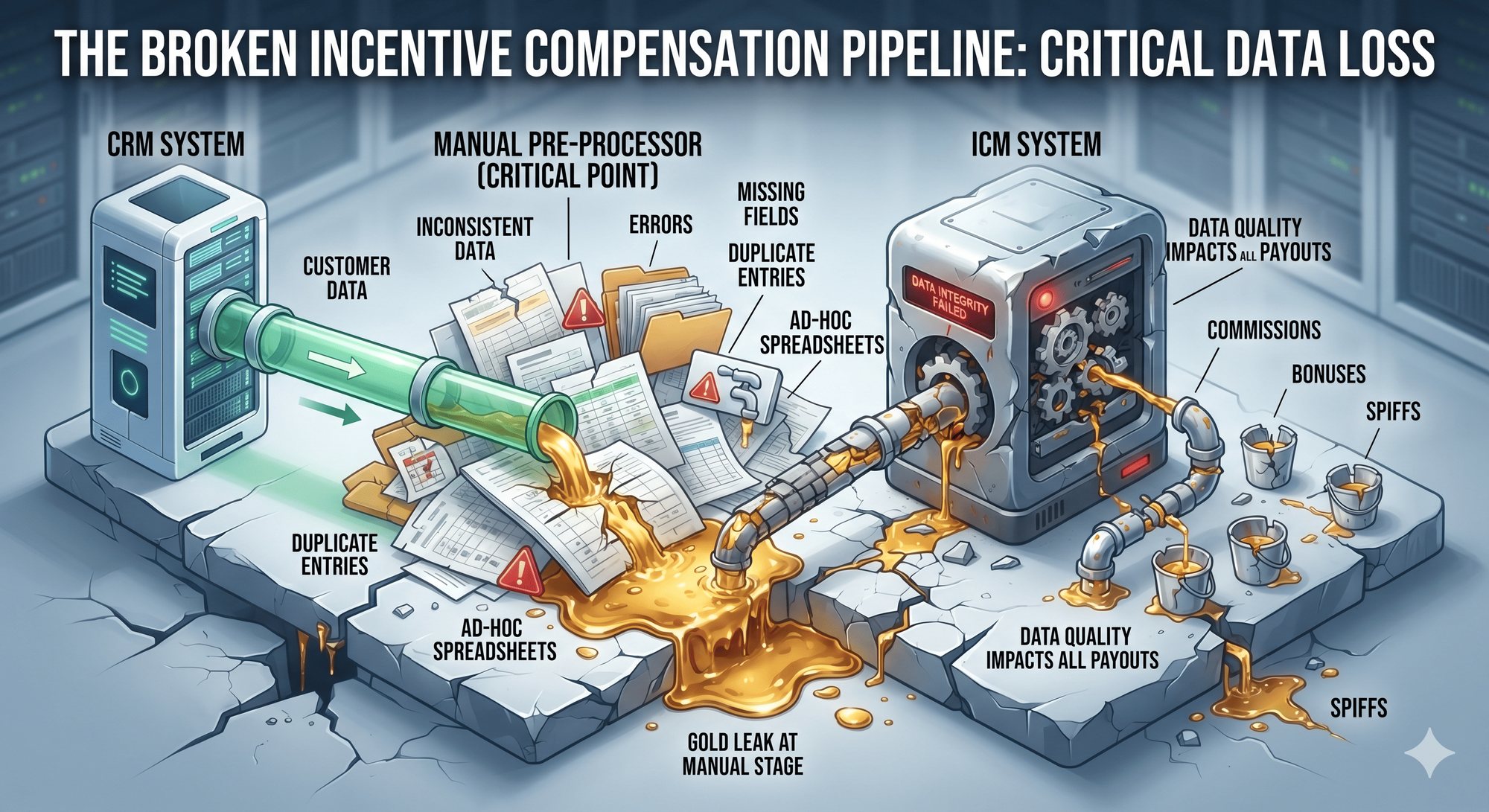
ICM implementations rarely fail because of the software. They fail because of five conditions that exist before the vendor is even selected: unmapped information flows, a hidden pre-processor, permissions designed as an afterthought, skipped discovery, and a rollout that ships because the money is spent. This piece walks through each one, what it looks like in practice, and a one-line self-test you can run before you sign anything. There is an interactive readiness score at the end.
The pattern nobody talks about
Here is the cycle as it actually plays out. A company buys an incentive compensation management system: Varicent, Xactly, CaptivateIQ, the brand matters less than everyone thinks. The implementation is rough. Go-live slips, statements come out wrong, admins drown in manual workarounds, and reps stop trusting the numbers. Someone senior says the system was a mistake.
Then the company does the one thing guaranteed to repeat the experience: it replaces the system.
I build and configure these platforms for a living, custom and commercial, so I have no incentive to defend any vendor. And in the rollouts I have examined, the software was almost never the root cause. The same five conditions were present every time, and every one of them predates the contract.
1. Nobody mapped the information flows
Every comp calculation is the end of a long chain: a deal closes in CRM, gets credited to a person or a team, splits across an overlay, rolls up a hierarchy, lands in a payout. In a surprising number of companies, no single person can draw that chain end to end. The knowledge lives in fragments: one analyst knows the crediting quirk for the channel team, another knows why the Q3 adjustments exist, a third runs the export that makes it all reconcile.
The implementation does not create this problem. It surfaces it. Configuration forces every fragment into the open at once, under deadline pressure, with a consultant billing by the hour. What looks like a system failure is the org meeting its own undocumented process for the first time.
Self-test: can anyone in your organization draw your crediting data flow on a whiteboard, today, without calling three other people? If not, this is your cause number one.
2. The hidden pre-processor
Somewhere between your source systems and your comp system sits a pre-processor. In a mature setup it is an integration job. In most real companies it is a person: someone who downloads the CRM export every Monday, fixes the territory mismatches, dedupes the splits, and uploads a clean file. The process works because that person makes it work.
Implementations price the system. Almost nobody prices the pre-processor. So the project plan assumes clean inputs that have never once existed, and the gap shows up mid-implementation as “data issues,” which get logged against the vendor. The vendor did not create your Monday-morning spreadsheet hero. The vendor just took away the place where their work was invisible.
Self-test: name every manual touch between your CRM and your comp calculation. If the list surprises you, the implementation will too.
3. Permissions and viewability, decided last
Who sees what is one of the most political questions in sales compensation. Should a regional manager see individual payouts across regions? Can a team lead see the accelerator table? Does finance see everything, and does HR?
In failed rollouts, these questions get answered during user acceptance testing, when someone finally clicks through as a manager and objects to what is on the screen. By then the role model is built. Retro-fitting permissions into a configured ICM system is not a tweak; it is rebuild-grade work, and it lands in the project’s most exhausted phase.
Self-test: who decided your role permissions and viewability rules, and when were they last deliberately reviewed? If the answer is “the system defaults decided,” that is the answer.
4. Discovery debt
Implementation projects are sold under deal pressure, and discovery is the phase that gets compressed to win the work. Requirements become a copy of last year’s plan documents plus a workshop. Edge cases, the actual substance of comp configuration, surface during build instead of before it.
This is the debt that compounds fastest, because every skipped requirement becomes a mid-build change order, every change order pushes the timeline, and a pushed timeline pressures the next phase to compress, which creates more debt. Projects do not go sideways at the end. They go sideways in week two and report it at the end.
And here is the replacement-system trap: when the rollout is finally blamed on the vendor and the company switches platforms, the new implementation re-runs the same compressed discovery, against the same undocumented process, often with the same deadline pressure. You do not have a vendor problem. You have a process debt problem, and it transfers.
Self-test: in your last implementation, what fraction of configuration decisions were made before build started? If you cannot answer, it was discovery debt.
5. The sunk-cost rollout
At some point a struggling implementation faces a choice: pause and fix the foundations, or ship because the money is spent. Almost everyone ships. The license is paid, the consultants are booked, leadership announced the go-live date in a town hall.
So a system that everyone inside the project knows is not ready gets rolled out to the field, where reps experience the unfixed problems as the product. First impressions in comp are nearly impossible to reverse, because compensation runs on trust, and the statement is the moment of trust. A rep who stops believing the number on the screen does not start believing it again because release 1.1 fixed the crediting rule.
Self-test: if your go-live date moved, who has the authority to say so, and would they survive saying it? If nobody, the rollout decision has already been made, regardless of readiness.
Score your readiness before you sign
The five conditions above are diagnosable in advance. Answer the five questions below, your score updates live. It is a thinking tool, not a guarantee, but it is the same set of questions that separates a clean rollout from a blamed one.
Five questions. One honest score.
Answer as your organization actually is today, not as the project plan assumes it will be.
This self-test mirrors the five conditions in this article. A low score is not a reason to avoid a platform, it is a list of things to fix before any platform, custom or commercial, can run cleanly.
What to do instead
None of these five conditions is fixed by a better vendor, a bigger implementation partner, or a longer contract. They are fixed before the deal: map the flows, surface and price the pre-processor, design permissions deliberately, fund real discovery, and pre-commit to readiness criteria that can actually delay a launch.
If you are currently evaluating platforms, do the buyer-side work first. Our SPM Buyer’s Checklist is the questions-to-ask-yourself version of this article. If your process is unusual enough that no off-the-shelf configuration fits cleanly, read why your next comp platform should be built, not bought before signing anything. And if you are mid-evaluation comparing vendors, the honest comparison work is in our SPM alternatives guide.
The system you pick matters. The five conditions matter more, and they are yours.
Frequently asked questions
Why do Xactly implementations fail?
For the same reasons any ICM implementation fails: unmapped data flows, unpriced manual pre-processing, permissions decided late, compressed discovery, and sunk-cost go-lives. These conditions exist in the buying organization before the vendor is selected, which is why switching vendors rarely changes the outcome.
Is CaptivateIQ (or Varicent, or Xactly) bad?
No. All major ICM platforms are capable systems with large successful installed bases. The better question is whether your organization can describe its own comp process precisely enough for any system to run it. If it cannot, the platform will expose that, and the rollout will be blamed.
How do I prepare for an ICM implementation?
Before signing: map your crediting data flow end to end, inventory every manual data touch, design role permissions and viewability deliberately, and protect the discovery phase from deal pressure. Pre-agree the criteria that would delay go-live.
Should I replace my ICM system?
Only after you can name what the current system exposed about your process and have fixed those things. A replacement inherits your process as-is. If the five conditions above are unaddressed, the new system will fail the same way, three years later.
Varicent, Xactly, and CaptivateIQ are trademarks of their respective owners. This article is independent professional commentary and is not affiliated with, sponsored by, or endorsed by any vendor.